

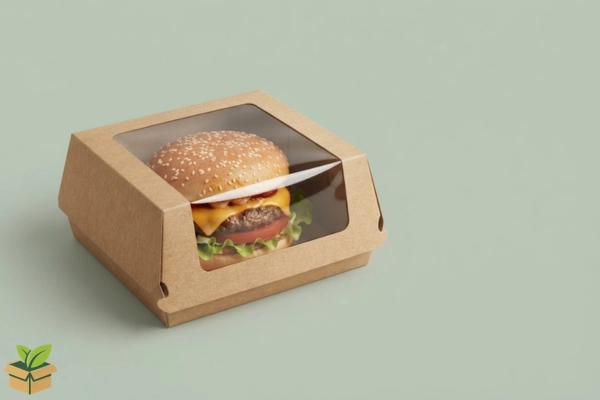
Burger Box with Window: Does It Help Sales?
If you’ve ever paused at a food stall just because you could see the juicy burger inside the box, you already know the answer intuitively. A burger box with window isn’t just a packaging trend — it’s a quiet sales strategy that fast-food brands, cloud kitchens, and street vendors across Pakistan are increasingly relying on. In this guide, we’ll unpack whether this small design choice genuinely moves the needle on sales, or if it’s just another packaging gimmick that looks good on Instagram but does little for your bottom line.
Spoiler: the data, psychology, and real-world restaurant behavior all point in the same direction — and we’ll walk you through exactly why.
📦 What Is a Burger Box with Window, Exactly?
At its core, a burger box with window is a standard food-grade burger container — usually kraft or white board — with a die-cut, transparent panel on the top or side. This cutout is covered with a food-safe clear film (PET or similar), allowing customers to see the product inside without opening the box.
It sounds simple, but the engineering behind it matters more than people assume. The window needs to be positioned precisely so it showcases the burger’s best angle, the film needs to withstand steam and oil without fogging too much, and the surrounding structure still has to protect the food from crushing during delivery. Brands sourcing from a reliable custom burger box with window supplier usually get this balance right — because a poorly placed window can actually hurt presentation instead of helping it.
Most window burger packaging falls into one of three categories:
- Full-top window – shows the entire burger from above, ideal for stacked or specialty burgers
- Side window – smaller cutout, often used for compact or value-menu burgers
- Die-cut shape window – custom shapes (circles, hexagons) used for premium branding
Each style serves a different purpose, and the right pick depends heavily on what you’re selling and who you’re selling it to.
👀 The Psychology Behind a Window: Why Customers Trust What They See
Here’s where things get genuinely interesting. Packaging psychology tells us that humans are wired to trust visual confirmation over verbal description. When a customer can see the lettuce, the melted cheese, or the grilled patty through a clear window burger box, their brain registers it as “proof” rather than “promise.” This single shift in perception is often enough to tip a hesitant customer into a confident buyer.
This ties directly into impulse buying through packaging — a well-documented retail phenomenon. In physical outlets, bakeries, and food courts, a visible product consistently outsells an identical hidden one, simply because visibility removes doubt. The same principle applies to food delivery platforms, where a thumbnail photo showing the window-packed burger often earns more clicks than a plain closed box shot.
There’s also a trust dimension at play. In food businesses, especially in markets where hygiene concerns run high, a transparent packaging benefit is that it signals “nothing to hide.” Customers subconsciously associate visibility with freshness and quality control. If you’ve ever wondered how packaging affects food sales in Pakistan, this psychological trust factor is one of the biggest reasons packaging choices directly correlate with revenue.
🚀 Does a Burger Box with Window Actually Help Sales?
Let’s get to the central question. Based on packaging industry data, restaurant feedback, and observed ordering behavior, the honest answer is: yes, in most cases — but with conditions.
A burger box with window helps sales primarily through three mechanisms. First, it increases product visibility packaging value at the point of sale, which matters enormously for walk-in and counter-service businesses where customers decide quickly. Second, it supports marketing through packaging on social media and delivery apps, where photos of visible, appetizing food consistently perform better than packaged mystery boxes. Third, it reinforces brand confidence — a business willing to “show” its product communicates quality assurance without saying a word.
That said, the sales lift isn’t automatic. A window only helps if what’s inside looks genuinely appealing. A soggy bun or messy assembly visible through a window can backfire just as easily as it can attract. This is why food quality and packaging design have to work together — something covered in more depth in our breakdown of how burger box packaging affects food quality. The window amplifies whatever is inside — good or bad — so presentation standards in the kitchen matter just as much as the box itself.
For businesses running takeout, dine-in, and delivery simultaneously, the sales impact tends to be strongest at physical counters and weakest (though still positive) for long-distance delivery, where the window’s visual advantage fades somewhat by the time the box reaches the customer.
🎯 Key Benefits of Window Burger Packaging for Your Brand
Beyond the direct sales angle, window burger boxes bring a handful of secondary advantages that compound over time. Restaurants that switch to window packaging often report improvements in customer engagement packaging metrics — things like repeat orders, positive reviews mentioning “presentation,” and increased willingness to try new menu items simply because they looked good through the box.
A few of the most consistently reported benefits include:
- Higher perceived value – customers associate visible, well-presented food with premium quality, even at mid-range price points
- Stronger social sharing – visually appealing window boxes get photographed and shared more often, acting as free marketing
- Reduced order anxiety – first-time customers feel more confident ordering when they can preview the product
- Brand differentiation – in a market full of plain closed boxes, a window stands out instantly on a counter or delivery bag
If you’re running a QSR or cloud kitchen and comparing packaging suppliers, it’s worth checking our guide on the best burger boxes for fast food restaurants in Pakistan — it covers how different box styles, including window variants, perform across different service formats.
🧾 Window Burger Box vs Traditional Closed Box: Quick Comparison
To put things side by side, here’s how window packaging stacks up against standard closed burger boxes across the factors that matter most to restaurant owners.
| Factor | Burger Box with Window | Traditional Closed Box |
|---|---|---|
| Customer visibility | High — product visible instantly | None — relies on branding/text only |
| Perceived freshness | Strong trust signal | Neutral, depends on branding |
| Best use case | Counter sales, dine-in, delivery photos | Bulk takeaway, budget menu items |
| Cost per unit | Slightly higher (die-cut + film) | Lower, simpler production |
| Heat/steam retention | Slightly reduced due to window area | Better insulation, fully sealed |
As the table shows, window packaging isn’t universally “better” — it’s a trade-off. You gain visibility and trust at a small cost to insulation and unit price. For premium burgers, specialty items, and dine-in presentation, that trade-off is almost always worth it. For high-volume, budget-tier, long-distance delivery items, a well-designed closed box may still make more operational sense.
🏪 Real Examples: How Pakistani Food Businesses Use Window Packaging
Walk through any food court in Lahore or Karachi, and you’ll notice a pattern. Premium burger brands and specialty cloud kitchens have shifted heavily toward window burger packaging over the past two years, while value-menu outlets largely stick to closed kraft boxes to manage costs.
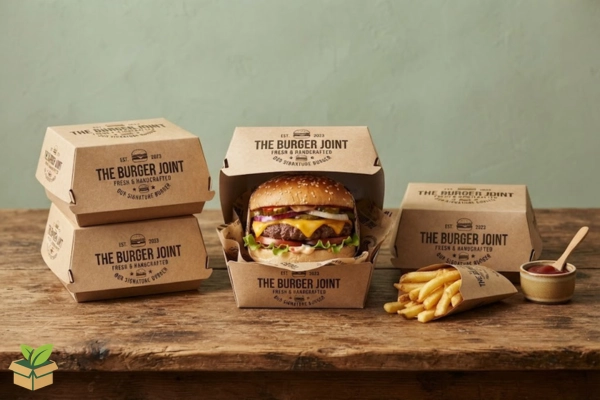
One common approach among growing cloud kitchen brands is using a custom burger box with window alongside branded printing — the window shows the product, while the printed exterior reinforces brand identity. This combination tends to outperform either element used alone. Businesses looking to go this route often start by exploring custom printed burger boxes, then add a window element once their branding design is finalized.
Smaller roadside and dhaba-style burger vendors, interestingly, have also started adopting basic window boxes — not for branding, but purely because customers in competitive, high-footfall areas respond better to visible food. It’s a low-cost way to compete with larger chains without matching their marketing budgets.
🌿 Material Choices: Kraft, White, and Eco-Friendly Window Boxes
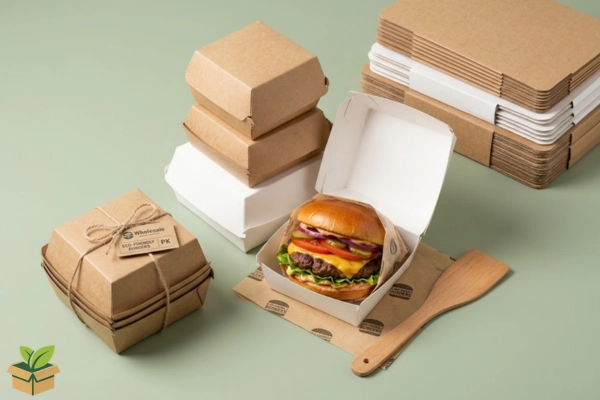
The material you choose for your window burger box affects both sales perception and sustainability credentials — two things increasingly linked in customers’ minds. Kraft burger boxes with a window tend to signal “natural, artisanal, eco-conscious,” which works well for premium or health-focused burger brands. White boxes, on the other hand, project a cleaner, more corporate, fast-food aesthetic, often favored by established chains.
If you’re torn between the two, our detailed comparison of kraft vs white burger boxes breaks down exactly which material suits which brand positioning. Beyond aesthetics, sustainability is becoming a genuine purchase driver — more Pakistani consumers now actively prefer brands using eco-friendly food boxes, and pairing a window design with recyclable kraft material checks both the “visibility” and “responsibility” boxes simultaneously. For restaurants exploring this shift, our piece on why eco-friendly burger boxes matter for your restaurant is a useful next read.
🛠️ How to Choose the Right Burger Box with Window for Your Restaurant
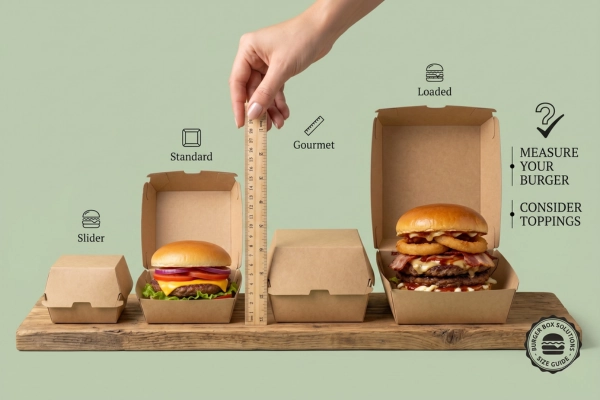
Picking the right window box isn’t just about aesthetics — it needs to match your burger size, service style, and delivery radius. A box that’s too small will crush the bun; one that’s too large lets the burger slide around and look messy through the window, undoing the very trust-building effect you were going for.
Start by nailing down your sizing using a resource like how to choose the right burger box size, since window placement only works well on a properly fitted box. From there, consider your service mix: if most orders go out for delivery, test how the window holds up after 20–30 minutes in transit — fogging and grease buildup can quickly turn a selling point into a turnoff. Dine-in and counter-heavy businesses have more flexibility here, since the window does its job within minutes of pickup.
Finally, think about branding consistency. A window only amplifies trust if the rest of the box — logo, color, print quality — matches the premium feel the window is trying to convey.
⚠️ Common Mistakes Restaurants Make with Window Packaging
Even a great packaging idea can underperform if implemented carelessly. The most frequent issue is oversized windows that expose too much of the burger, including the less photogenic parts — a flipped-over bun or oozing sauce can do more harm than good. Another common slip-up is ignoring heat retention, assuming the window has zero impact on temperature, when in reality a large cutout does let heat escape faster for delivery orders.
A few other mistakes worth watching for:
- Using a window on burgers with messy, hard-to-stack ingredients
- Skipping grease-resistant film, leading to foggy, unappetizing windows
- Mismatched branding where the printed box looks premium but the burger inside doesn’t match
These are exactly the kinds of oversights covered in our broader guide on common packaging mistakes small businesses make — worth a read before finalizing your next packaging order.
📈 Packaging Trends: Where Window Boxes Fit in Pakistan’s Market
Window packaging isn’t an isolated trend — it’s part of a broader shift in how Pakistani food businesses think about presentation and sustainability together. As competition in the fast-food and cloud kitchen space intensifies, visual differentiation has become almost as important as taste itself. Our full roundup of packaging trends in Pakistan shows window boxes sitting alongside eco-friendly materials and minimalist branding as one of the fastest-growing packaging preferences this year.
What’s notable is that this trend isn’t limited to premium brands anymore. Mid-tier and even budget operators are experimenting with window boxes selectively — using them for signature items while keeping standard closed boxes for everyday orders. This hybrid approach captures the sales benefit of visibility without inflating packaging costs across the entire menu.
✅ Final Verdict: Is It Worth the Investment?
So, does a burger box with window actually help sales? Based on consumer psychology, real restaurant behavior, and the trade-offs we’ve walked through, the answer leans firmly toward yes — provided it’s used strategically rather than universally. For dine-in experiences, premium menu items, and brands trying to build visual trust, the window consistently earns its keep by boosting perceived value, encouraging impulse decisions, and strengthening brand recall.
The key takeaway is that packaging never works in isolation. A window burger box amplifies whatever is already true about your product and brand — so pair it with solid food presentation, the right material, and consistent branding, and you’ll likely see the sales lift this packaging style is known for.
If you’re ready to test window packaging for your menu, explore EcoPackaging’s full range of custom burger boxes with window and find the size, material, and finish that fits your brand — your next order could be the one that finally gets your burgers noticed before they’re even opened.
❓ Frequently Asked Questions
Does a burger box with window really increase sales? Yes, in most cases. Visible packaging builds trust and triggers impulse buying, especially in counter-service and dine-in settings, though the effect is slightly reduced for long-distance delivery orders.
What material is best for a window burger box? Kraft material with a window suits eco-conscious and premium brands, while white boxes work well for brands going for a clean, corporate fast-food look.
Does the window affect how long a burger stays warm? Slightly, yes. The cutout area reduces insulation marginally compared to a fully closed box, so it’s best suited for quick-service or short-delivery scenarios.
Can small businesses afford window burger packaging? Absolutely. Many small and mid-sized restaurants use window boxes selectively — only for signature or premium items — to balance cost with visual impact.
Is a window burger box better than custom printing alone? They work best combined. A window builds trust through visibility, while custom printing reinforces brand identity — using both together typically delivers the strongest sales impact.










(0) Comments